Fano-suppression in scattering resonances of erbium

Check out our latest paper on arxiv!

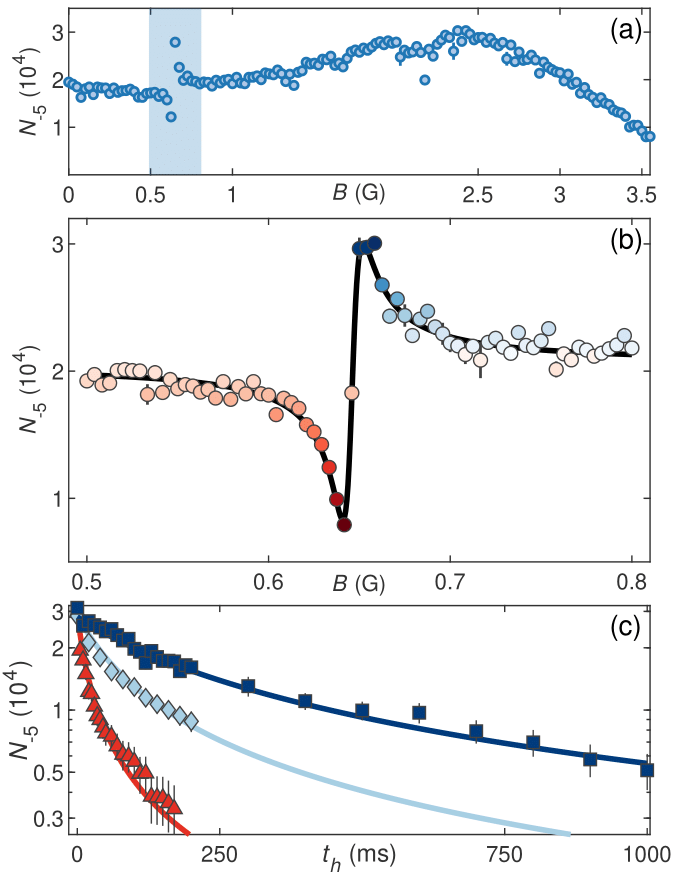
Through a combined effort between the Erbium Lab, Prof. Nirav Mehta from Trinity University and Prof. Seth Rittenhouse from the United States Naval Academy, our new preprint demonstrates the first observation of Fano profiles in scattering resonances of ultracold atoms. We show that these features arise from destructive interference between multiple scattering pathways, which we theoretically capture using a simplified multichannel model. Our work opens the door to detailed investigations of multispin, strongly coupled scattering phenomena.
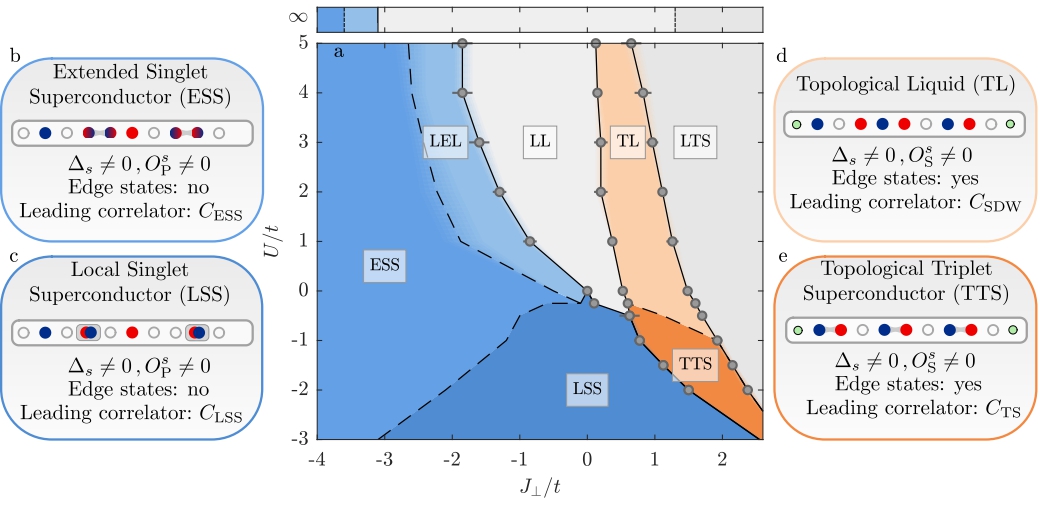
Topology meets superconductivity in a one-dimensional t-J model of magnetic atoms

We have published a new paper by our theory + erbium team on arxiv!

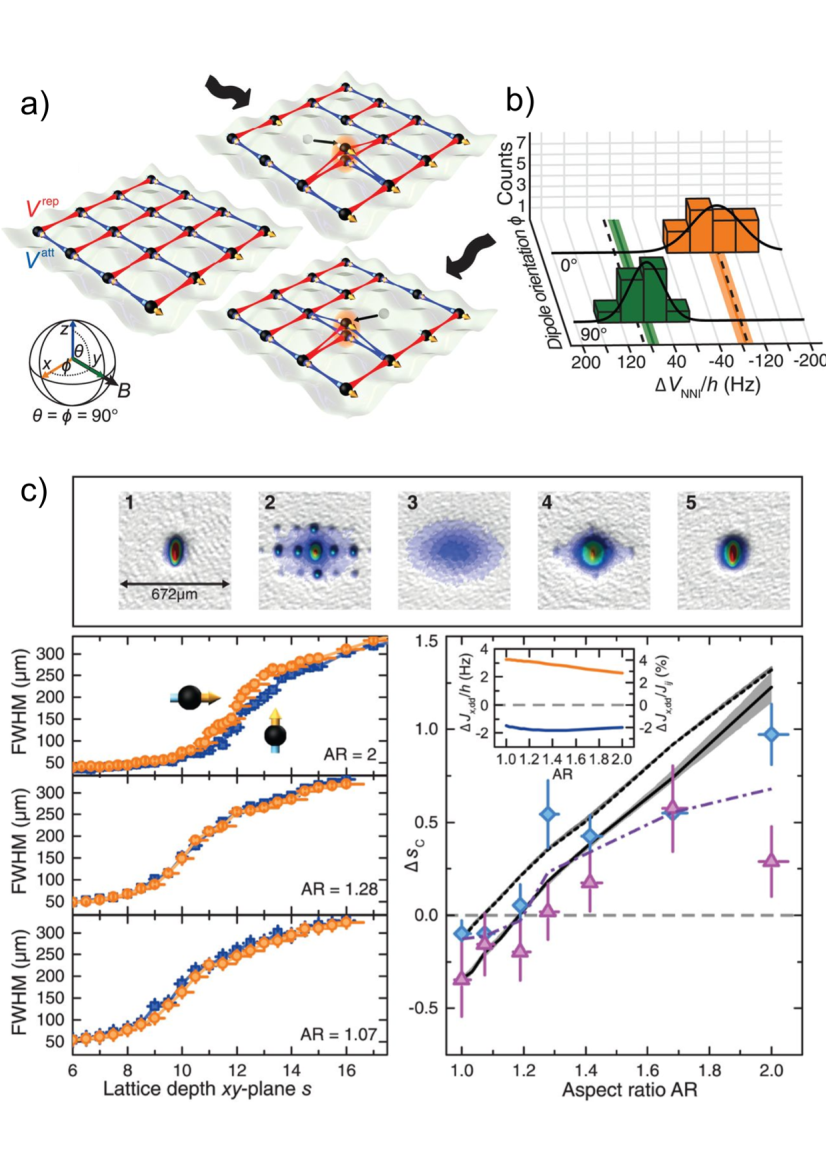
In this work, we leverage the special properties of ultracold magnetic lanthanide atoms trapped in optical lattices, to create a highly controllable version of the iconic t-J model, a cornerstone of quantum many-body physics. We uncover a wide range of exotic phases, including superconducting, topological, and—most strikingly—topological superconducting states. The latter presents several aspects of novelty. The most intriguing one is that differently from the paradigmatic example of one-dimensional topological superconductivity appearing in the celebrated Kitaev chain, this phase is purely induced by competing interactions. We also outline how these phases can be realized and detected with current experimental tools, opening a powerful new route for a deeper understanding of strongly interacting fermionic quantum matter.

Review of quantum simulations of non-standard Bose-Hubbard models

The article “Recent progress on quantum simulations of non-standard Bose-Hubbard models” by Priv. Doz. Dr. Manfred Mark and collaborators has been accepted to Reports on Progress in Physics! The field of quantum simulation of Hubbard models has been growing extensively in the past decade. Here, we focus specifically on non-standard Bose-Hubbard models and discuss the progress made in both, the theoretical description and understanding as well as in the first experimental realizations.

Read the full article in Reports on Progress in Physics!

Optical Manipulation of Spin States in Ultracold Magnetic Atoms

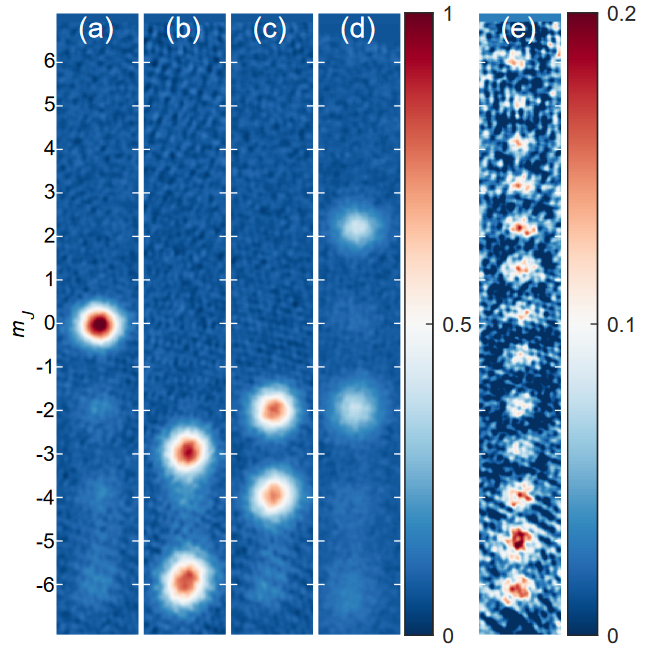
ImageWe present an all-optical method for deterministically controlling the spin composition of a quantum gas, based on a clock-like transition, and demonstrate that this transition can also be used to create spin-selective light shifts! 

The article has now been published in Physical Review Research, and the pre-print can be accessed here: arxiv.org/abs/2405.01499.

Der Suprafestkörper: a popular science article on the dipolar supersolid!

imageIf you have been searching for a high-level overview of the dipolar supersolid phase, look no further than this open access article by Prof. Francesca Ferlaino and Dr. Manfred Mark! Newly published in the journal “Physik in unserer Zeit”, this German language primer lays out the historical background, newly discovered properties and open questions which remain about this paradoxical quantum phase. See the full article below:
Ferlaino, F. and Mark, M.J. (2024), Der Suprafestkörper. Phys. Unserer Zeit. https://doi.org/10.1002/piuz.202301692

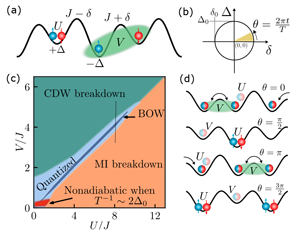
A Thouless pump with dipolar interactions

Thouless pumping represents a powerful concept to probe quantized topological invariants in quantum systems. We explore this mechanism in a generalized Rice-Mele Fermi-Hubbard model characterized by the presence of competing onsite and intersite interactions. While large on-site repulsion leads to a breakdown of quantized pumping , sufficiently large intersite interactions allow for an interaction-induced recovery of Thouless pumps. The stable topological transport at large interactions is connected to the presence of a spontaneous bond-order-wave in the ground-state phase diagram of the model. We also discuss a concrete experimental setup based on ultracold magnetic atoms in an optical lattice.

The article can be found here: Quantum, the pre-print can be accessed here: arXiv