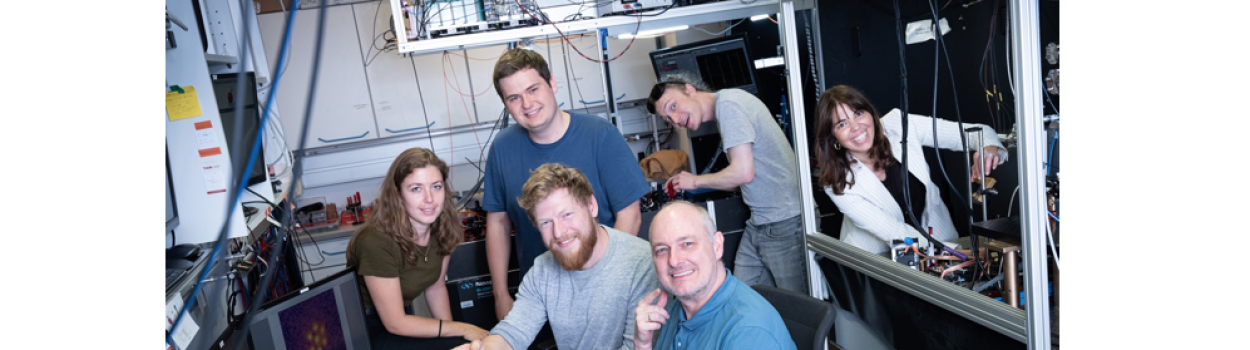


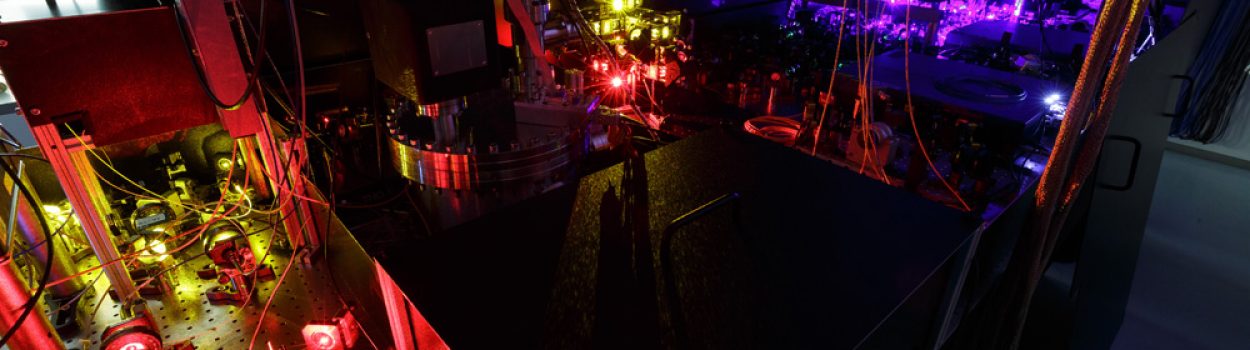
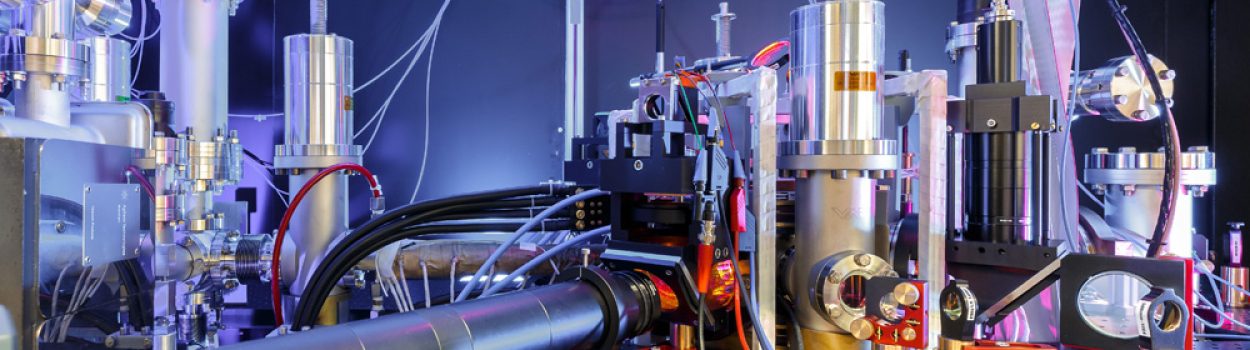
The Er-Dy LAB focuses on many-body quantum phenomena in a dipolar quantum mixture of two highly magnetic lanthanides, Erbium and Dysprosium.
The designing process of the experimental apparatus started in late 2014 and several concepts have been developed in collaboration with our ERBIUM Team and the Er-Team at Harvard University led by Markus Greiner.
Er-Dy mixtures
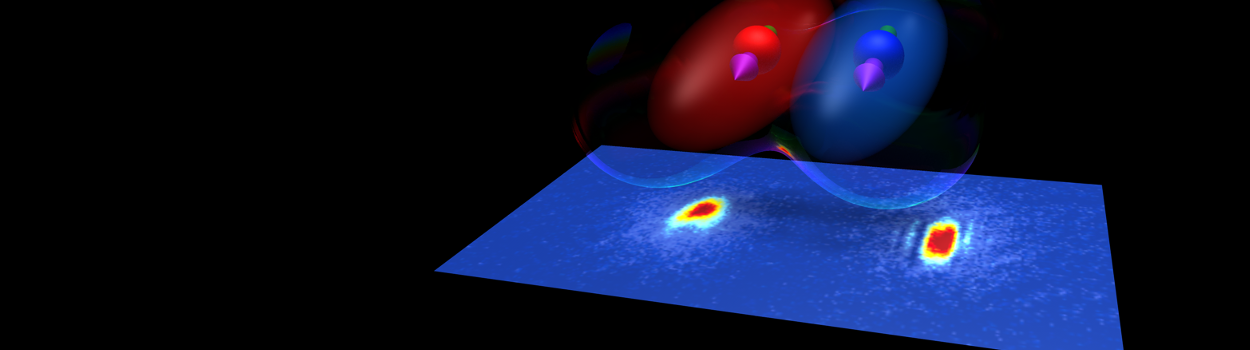
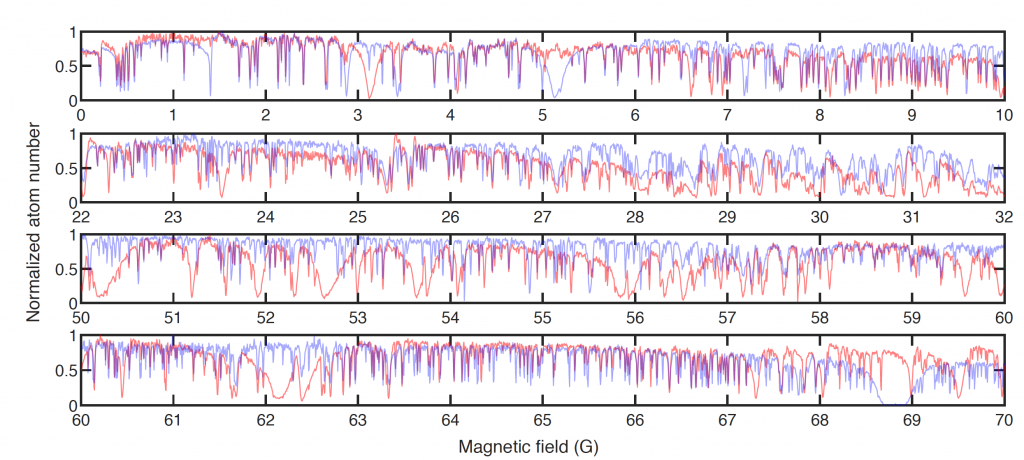
In 2018, we produced the first quantum degenerate dipolar mixture of Erbium and Dysprosium [1]. Our setup can operate with either species alone or with Bose–Bose, Bose–Fermi, and Fermi–Fermi mixtures. By carefully controlling the dipole orientation, we demonstrated tunable interspecies interactions [2], providing a foundation for exploring miscibility–immiscibility, quantum droplets, and supersolids in heteronuclear dipolar gases.
Supersolids
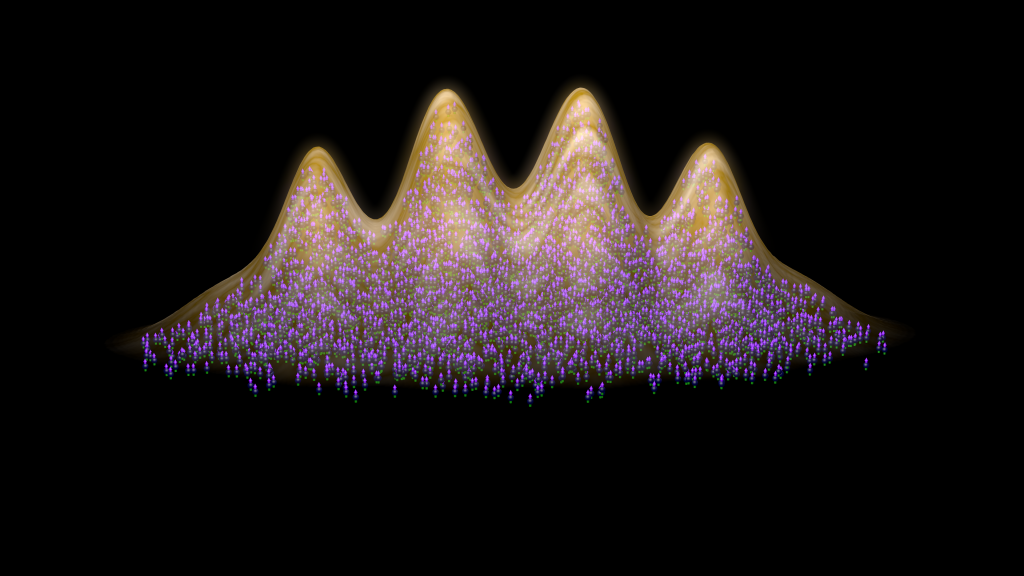
Dipolar gases can form supersolids, states that combine the frictionless flow of a superfluid with the crystalline order of a solid. In 2019, a long-lived supersolid was realized through a collaboration between the Er-Dy LAB, ERBIUM LAB, and theory collaborators at IQOQI [3]. Building on this, we achieved the first two-dimensional supersolid [4], and studied its phase coherence [5], collective excitations, and non-equilibrium dynamics, revealing how superfluidity and crystalline order coexist in complex, tunable quantum systems.
Vortices
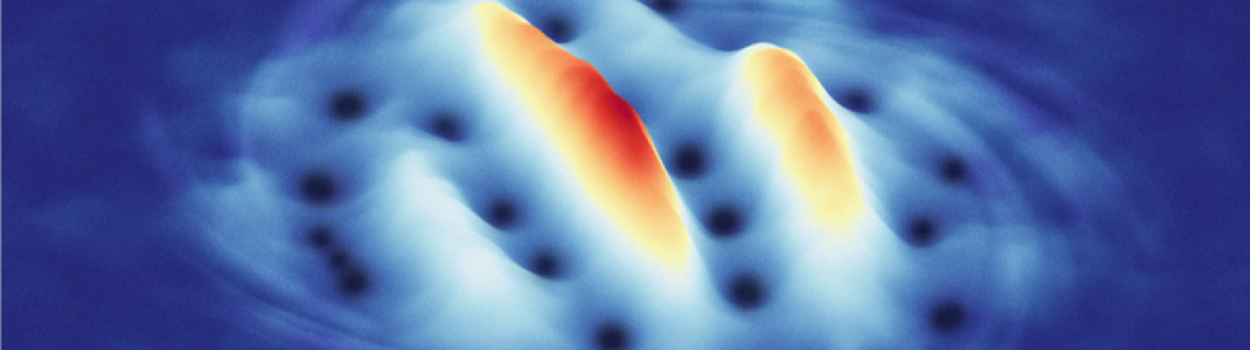
We have investigated quantized vortices and vortex patterns in dipolar quantum gases, revealing how superfluid flow interacts with dipolar interactions.
- In dipolar Bose-Einstein condensates, we observed vortex stripes, where alternating rows of vortices emerge due to the anisotropic dipolar interaction [6].
- In dipolar supersolids, we detected vortices embedded within the supersolid structure, providing a direct demonstration of superfluidity coexisting with crystalline order [7].
These studies open the door to simulating exotic rotating systems, including scenarios relevant to neutron-star physics, as suggested by our Theory Group.
A microscope for dipolar atoms
We are developing a quantum gas microscope for highly magnetic atoms [8], enabling single-atom resolution in optical lattices. Unlike conventional microscopes, ours is designed for atoms with strong, long-range dipole-dipole interactions, opening access to a completely new class of quantum systems. The inter-atomic dipole-dipole interaction adds a new term to the Hamiltonian describing the ensemble, and therefore allows us to investigate a whole new class of quantum systems. The behavior of the system will critically depend on the interplay between the different interaction terms, whose magnitude and direction dependence may be tuned experimentally over a wide range. Thus, a large variety of interesting quantum systems can be simulated and investigated.
[1] For a general overview of this work, see our writeup. This work was published in PRL, and the preprint can be found on the arXiv.
[2] For a general overview of the study, see our writeup. This work was published in PRA, and the preprint can be found on the arXiv.
[3] For a general overview of the supersolid phase, see our writeup and the press release by UIBK, and the article by Physics Magazine. This work was published in Physical Review X, and the preprint can be found on the arXiv. See also the experiments from Giovanni Modugno in Pisa and from Tilman Pfau in Stuttgart.
[4] For a general overview of 2D supersolidity, see our writeup, the press release by UIBK, the article by Physics Magazine, and the News & Views by Bruno Laburthe-Tolra. This work was published in Nature, and the preprint can be found on the arXiv. More related publications can be found below.
[5] For a general overview of the phase coherence, see our writeup. This work was published in Nature Physics, and the preprint can be found on the arXiv.
[6] For a general overview of vortices in the BEC, see our writeup, and the News & Views by Z. Hadzibabic. This work was published in Nature Physics, and the preprint can be found on the arXiv.
[7] For a general overview of the observation of vortices in a dipolar supersolid, see our writeup, the press release by UIBK, or the articles by Physics Magazine and Quanta Magazine. The article was published in Nature, and the preprint can be found on the arXiv.
[8] For a general overview of our design, see our writeup. This work was published in SciPost Phys., and the preprint can be found on the arXiv.
A full list of the Er-Dy Lab Publications can be found here
Interested in joining us? Check out here.

Francesca Ferlaino, Univ.-Prof. Dr.
Group Leader / PI

Manfred Mark, Dr.
Senior Scientist / Research Assistant

Andrea Litvinov, Dr.
Post Doc

Eva Casotti, MSc.
PhD Student (Er-Dy)
Clemens Ulm, MSc.
PhD Student (Er-Dy)

Gerard Solà Berga, MSc.
PhD Student (Er-Dy)