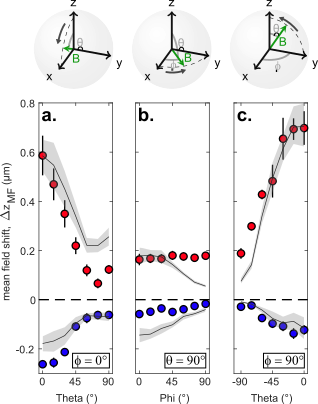
We present a first study of the influence of the dipole-dipole interaction on the total inter-species interaction in our erbium-dysprosium mixture. In collaboration with M. Modugno from the University of the Basque Country, we develop a model for our heteronuclear mixture, which describes qualitatively well our system and allows us to predict a lower and an upper bound for the inter-species scattering length. With this work, we make the first steps toward the study of the experimentally unexplored miscibility-immiscibility phase diagram and the realization of quantum droplets and supersolid states in heteronuclear dipolar mixtures.
This work is now published as the editors’ suggestion in Phys. Rev. A [paper][arXiv]
Applications have now opened for the Introductory Course on Ultracold Quantum Gases 2022 winter school. This will take place in Innsbruck between the 9th and 11th February 2022. Please visit the website for more information and to apply.
Farewell to Matthew Norcia who after an incredible two years here is moving back to Boulder (US). We wish you all the best for your next scientific adventure!
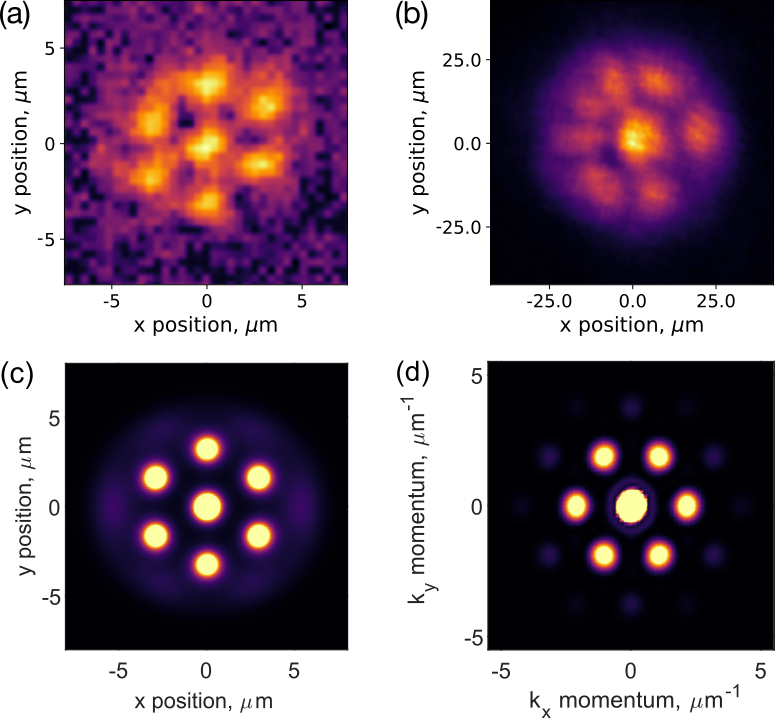
Figure: Experimental realisation of a two-dimensional seven droplet hexagon state. (a) In-situ image of density profile. (b) Image after 36 ms time-of-flight expansion. (c,d) Corresponding theory result for the same trap. In (d), the time-of-flight expansion is estimated by a Fourier transform of the wavefunction.
Dipolar condensates were recently coaxed into supersolid phases supporting both superfluid and crystal excitations. The first dipolar supersolids consisted of one dimensional droplet arrays, and a recent experiment here achieved two dimensional supersolidity, observing the transition from a linear chain to a zig-zag configuration of droplets.
In this work, in collaboration with Prof. Luis Santos from the Leibniz University Hannover, we show that while one-dimensional supersolids may be prepared from condensates via a roton instability, such a procedure in two dimensions tends to destabilise the supersolid. By evaporatively cooling directly into the supersolid phase–hence bypassing the roton instability–we experimentally produce a 2D supersolid in a near-circular trap, an observation verified through state-of-the-art finite temperature simulations. We show that 2D roton modes have little in common with the supersolid configuration, instead, unstable rotons produce a small number of central droplets, which triggers a nonlinear process of crystal growth. We calculate excitations for a 2D supersolid ground state, and make comparisons with 1D arrays using the static structure factor. These results provide insight into the process of supersolid formation in 2D, and define a realistic path to the formation of large two-dimensional supersolid arrays.