2024’s Biggest Breakthrough in Physics

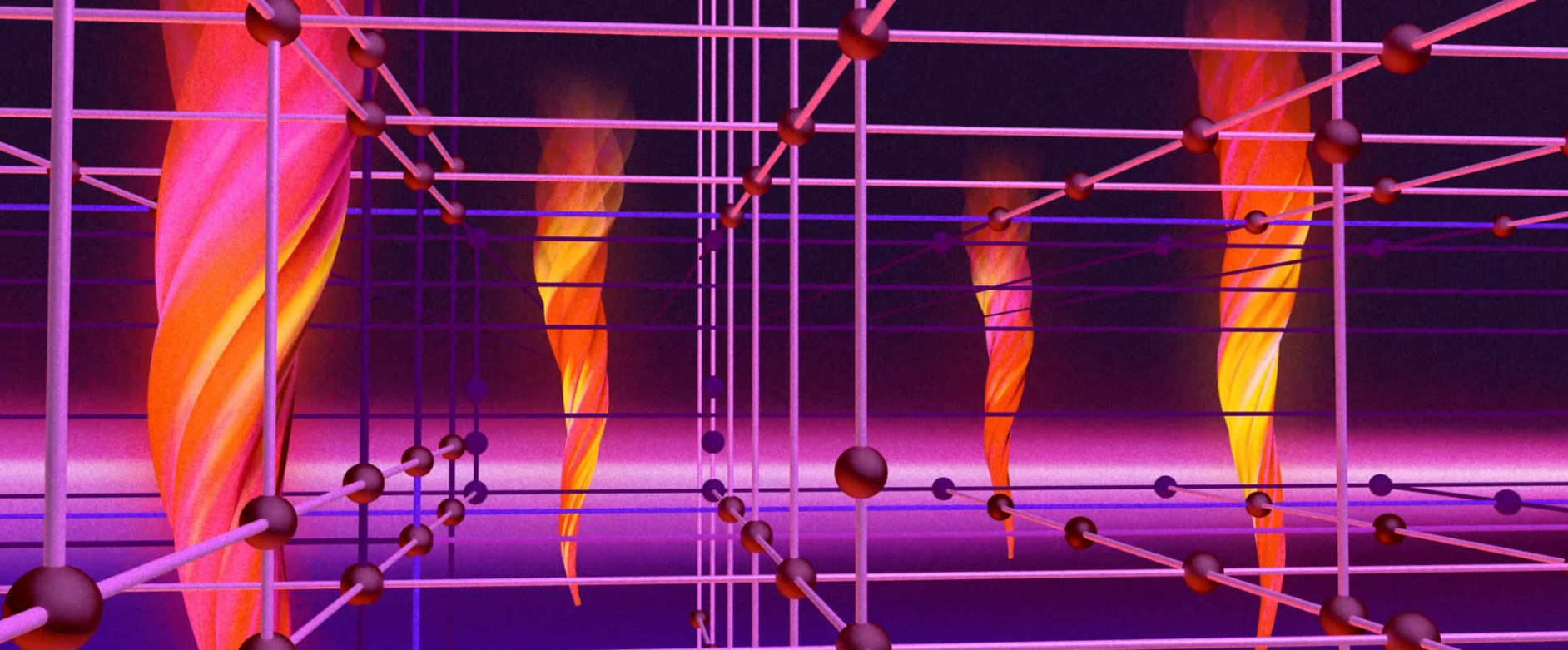
Quanta Magazine has declared our research on the ‘Observation of vortices in a dipolar supersolid‘ one of 2024’s Biggest Breakthrough in Physics!

Moving from the largest stage to the very smallest one, physicists who manipulate atoms, molecules and crystals in the lab have also spent 2024 in the throes of discovery, having achieved astonishing levels of precision and control over their quantum quarries. A team in Innsbruck created a long-predicted exotic state of matter called a supersolid, and even imaged the hallmark “quantum tornadoes” that formed when they stirred an otherwise rigid crystal of dysprosium atoms. Astrophysicists suspect that this supersolid phase might arise inside incredibly dense, fast-spinning stars called pulsars.

Read the rest of 2024’s Biggest Breakthroug here: The Year in Physics

Watch the Quanta video, featuring Francesca and PhD student Elena Poli, here: Youtube Explainer

Read the feature by Quanta Magazine here: Physicists spot quantum tornadoes twirling in a supersolid

See the article in Nature here: Observation of vortices in a dipolar supersolid

Read the pre-print here: arXiv:2403.18510.

Dancing supersolids synchronize


In collaboration between the Er-Dy Lab and the Theory subgroup, and Dr. Giacomo Lamporesi at the BEC centre in Trento, our new pre-print reveals a fundamental difference in a supersolid’s response to rotation in absence or presence of a quantum vortex. This work builds on our previous investigation of vortices in supersolids, showing that the superfluid and solid natures synchronize to the external rotation only when there are vortices in the state. We verify this theoretical prediction in the experiment, revealing the route to vortex nucleation in supersolids.

See the pre-print here: https://arxiv.org/abs/2412.11976

Optical Tweezer Arrays of Erbium Atoms


Optical Tweezer Arrays of Erbium Atoms
Image credit: D. S. Grün, University of Innsbruck

Now published in the journal “Physical Review Letters”, and featured in Physics Magazine as an Editors’ Suggestion!

The T-REQS Lab presents the first successful trapping of single erbium atoms in an array of optical tweezers, marking a significant milestone in the use of erbium for quantum simulation. For the experimental details of this achievement by the T-REQS team, see the following excerpt from the abstract:

Using a single narrow-line optical transition, we achieve deep cooling for direct tweezer loading, pairwise ejection, and continous imaging without additional recoil suppression techniques. Our tweezer wavelength choice enables us to reach the magic trapping condition by tuning the ellipticity of the trapping light. Additionally, we implement an ultrafast high-fidelity fluorescence imaging scheme using a broad transition, allowing time-resolved study of the tweezer population dynamics from many to single atoms during light-assisted collisions. In particular, we extract a pair-ejection rate that qualitatively agrees with the semiclassical predictions by the Gallagher-Pritchard model.

See the article in PRL here: https://journals.aps.org/prl/abstract/10.1103/PhysRevLett.133.223402

Read the Physics Magazine Synopsis here: https://physics.aps.org/articles/v17/s151

See the pre-print here: Optical Tweezer Arrays of Erbium Atoms arxiv.org/abs/2405.01499.

Goodbye to Andrea Di Carli

We said goodbye to Academy Scientist Andrea Di Carli at the end of October 2024! Dr. Di Carli joined the Ferlaino Group from the University of Strathclyde in March 2023, and he has now moved into an industry position in Munich. Best of luck at your new position, Andrea!