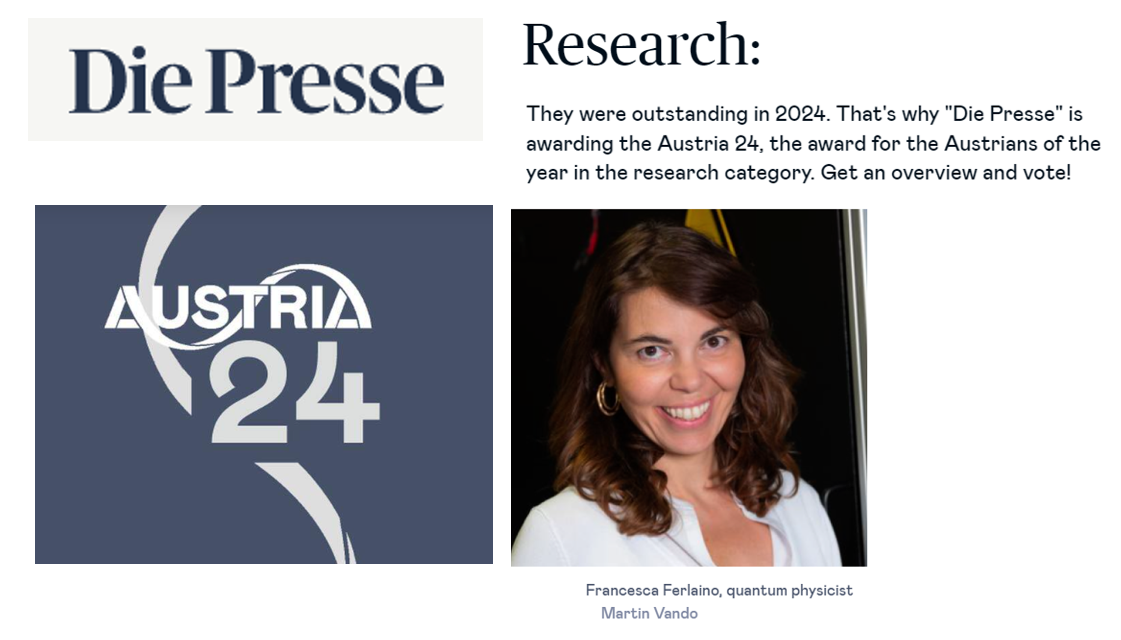
Die Presse – the Austrian newspaper of record – has nominated Francesca for Austria 24, the Austrians of the year in the research category! This prestigious award is given to personalities who have achieved excellence in their field, and are honored in six categories:
International success
Research
Humanitarian commitment
Climate initiative
Cultural heritage
Company with responsibility
On Saturday the 26th of October 2024, at 17:25 ORF will broadcast the “Austrians of the year” awards ceremony, where Francesca is one of the 3 finalists in the category of research.
You can watch the program here:
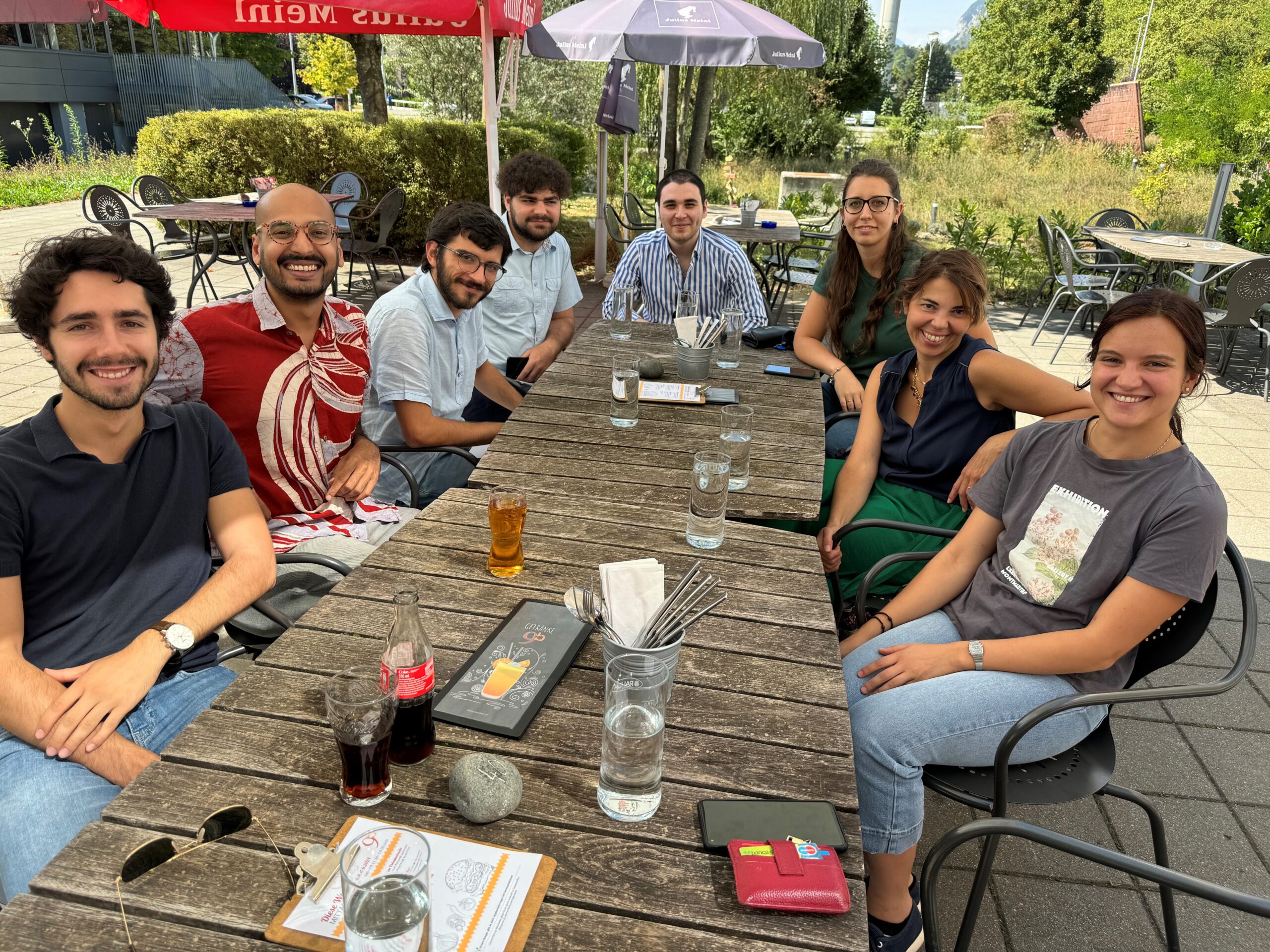
From left to right: Leonardo Bellinato Giacomelli, Pramodh Senarath Yapa, Giuseppe Puca, Gianlorenzo De Filippo, Matteo Olimpo, Elena Poli, Francesca Ferlaino and Silvia Trabucco.
The first week of September 2024 marked the end of the 3 weeks of the Aurora Excellence Fellowship program and the beginning of a visit by Silvia Trabucco, who is a PhD student at Gran Sasso Science Institute in L’Aquila, Italy. Silvia is visiting to build upon an already successful collaboration regarding vortices in a dipolar supersolid and their connection to glitches in neutron stars.
Silvia Trabucco graduated in theoretical physics in Pisa in 2021 with a thesis about thermal properties of acoustic horizons realised with Bose-Einstein condensates. She joined the PhD program at the Gran Sasso Science Institute in L’Aquila, Italy. Her research interests include quantum simulation of gravitational black holes and their beyond-equilibrium properties, as well as phases of matter realised in compact stars. She worked with the University of Innsbruck to investigate the glitch mechanism of neutron stars employing dipolar supersolids.
The Aurora interns Gianlorenzo De Filippo, Matteo Olimpo and Giuseppe Puca made remarkable progress in their projects with the Theory team over the last 3 weeks, and we wish them the best of luck with their research at University of Naples Federico II!
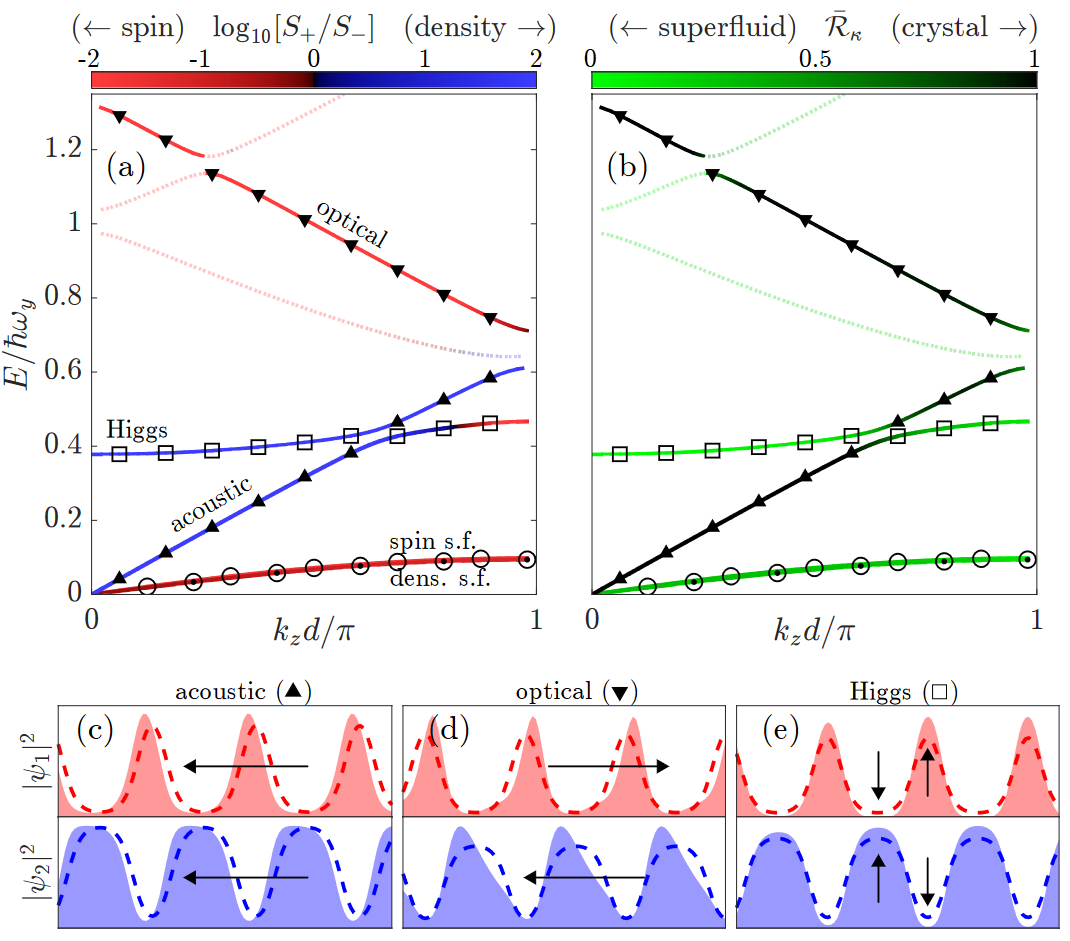
Now published in Physical Review Letters! With colleagues here in Innsbruck and at the University of Otago, NZ, we predict a rich excitation spectrum of a binary dipolar supersolid in a linear crystal geometry, where the ground state consists of two partially immiscible components with alternating, interlocking domains. We identify three Goldstone branches, each with first-sound, second-sound or spin-sound character. In analogy with a diatomic crystal, the resulting lattice has a two-domain primitive basis, and we find that the crystal (first-sound-like) branch is split into optical and acoustic phonons. We also find a spin-Higgs branch that is associated with the supersolid modulation amplitude.
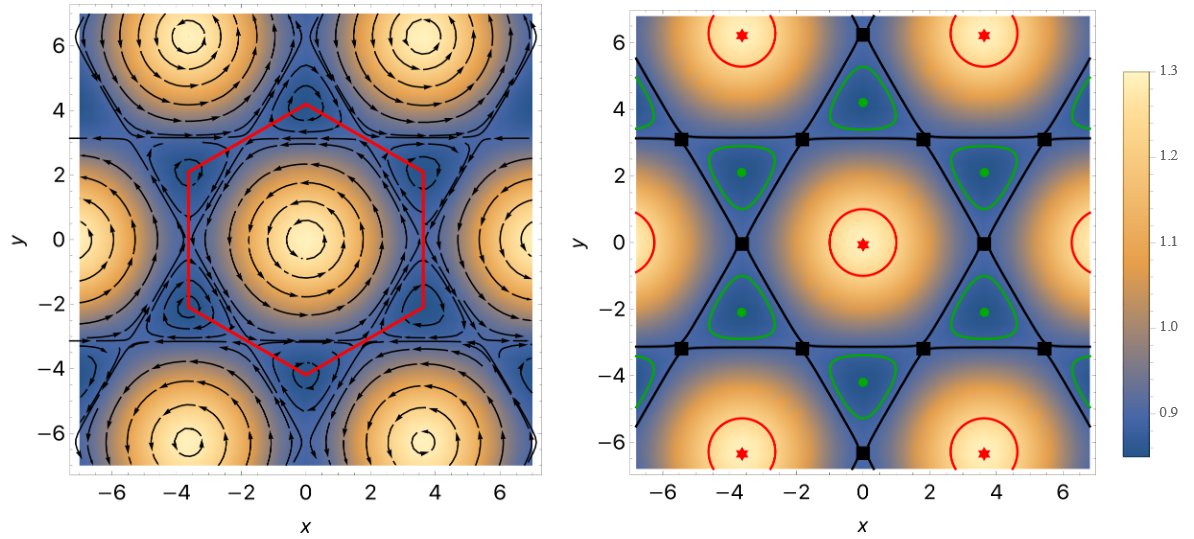
Now published in the journal “Few-Body Systems”! Together with collaborators at Laboratori Nazionali del Gran Sasso, we investigate the pinning dynamics of vortices in rotating dipolar supersolids. This work is a follow-up our paper last year on how glitches in the supersolid serve as a versatile analogue of the same behaviour in neutron stars.
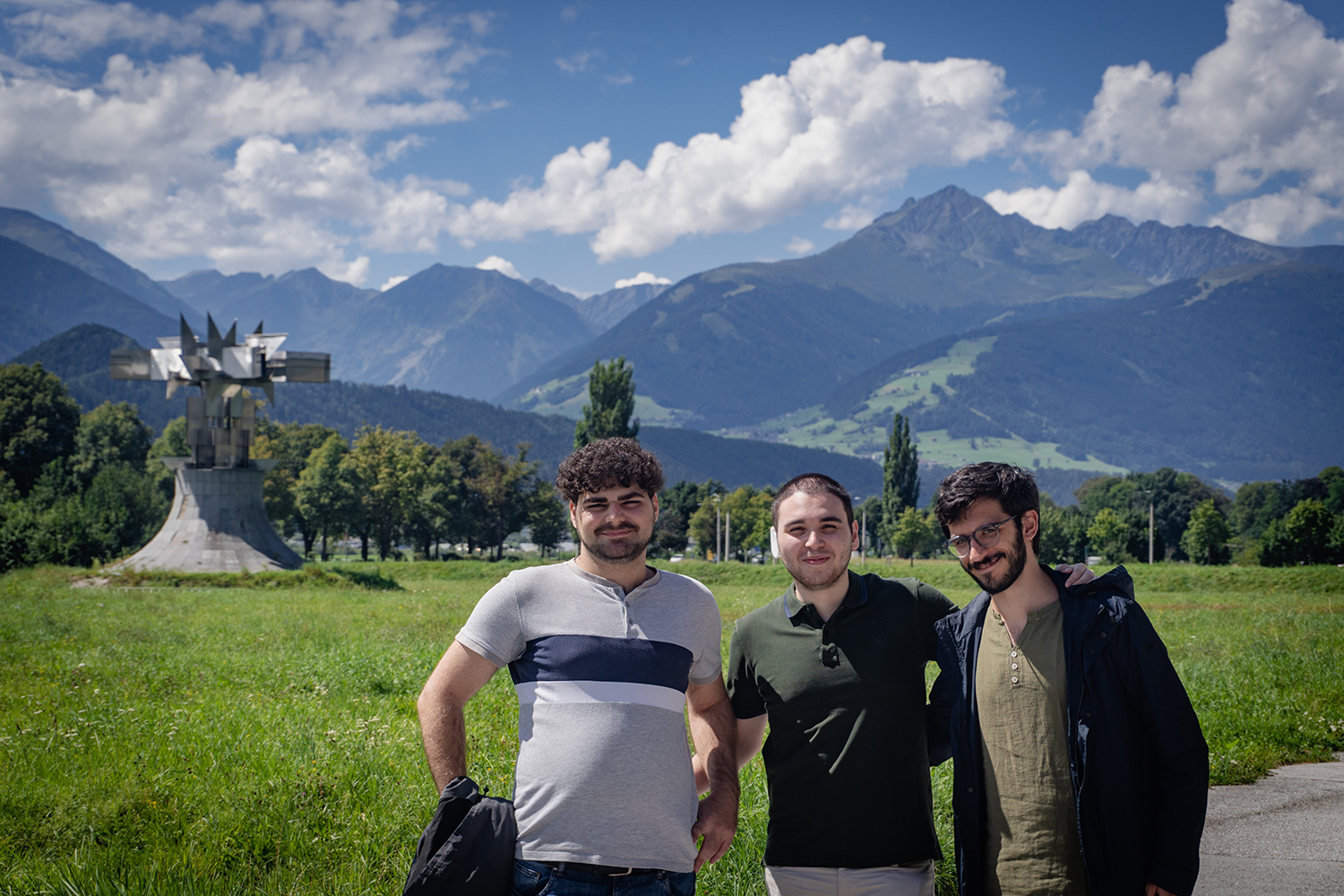
From left to right: Gianlorenzo De Filippo, Matteo Olimpo and Giuseppe Puca.
On the 19th of August 2024, we welcomed three Masters’ interns to the Theory team under the Aurora Excellence Fellowship program!Gianlorenzo De Filippo, Matteo Olimpo and Giuseppe Puca will be with us for 3 weeks working on projects about supersolidity and lattice physics.
Gianlorenzo is from Formia in Italy and he is a Master degree student in astrophysics at the University of Naples Federico II. For the AURORA project he will be studying the supersolid phase transition in quantum gases and its relation to neutron star glitches.
Matteo was born on December 1, 2001, in Naples, Italy. He began his studies in physics in 2020 at the University of Naples Federico II, where he graduated in 2023 with a thesis on percolation theory. He is currently studying for a master’s degree in theoretical physics at the same university.
Giuseppe was born on October 19, 2001, in Naples, Italy. He obtained his Bachelor’s degree in Physics from the University of Naples Federico II on October 2, 2023, with a thesis on the derivation of the Unruh effect using Feynman’s path integral formulation. He continued his studies in Naples, where he is currently enrolled in the Master’s degree program in Physics with a specialization in Theoretical Physics. Since 2020, he has been a student in the Ordinary Course in “Cosmology, Space Science, and Space Technologies” at the Scuola Superiore Meridionale in Naples. His current interests include statistical mechanics, complex systems, quantum many-body systems, quantum field theory and numerical methods.
We said goodbye to Antonio Ortu at the end of July 2024. Dr. Ortu joined the T-REQS lab as a Post-doc in May 2022, and has now moved to Copenhagen for a scientific staff position. Good luck at your new position, Antonio!