In the Framework of the Quantum Austria Initiative a joint project from the University of Innsbruck and the TU Wien was awarded and starts at the beginning of 2023. The “Austrian Quantum Simulator Infrastructure” project with a total funding of about 3 Million Euros will greatly enhance the already existing quantum simulators in several labs in Innsbruck and Vienna and also help in the building up of new simulators. Quantum simulators are a very powerful tool to study complex quantum systems by mimicking their behaviour with a quantum system which is fully controllable. The project consortium combines a great variety of physical systems which are used as simulators, including solid-state systems, ultracold atoms and trapped ions. Our group is participating with our long-range interacting atoms inside an optical lattice and our Rydberg tweezer array experiment.
FF
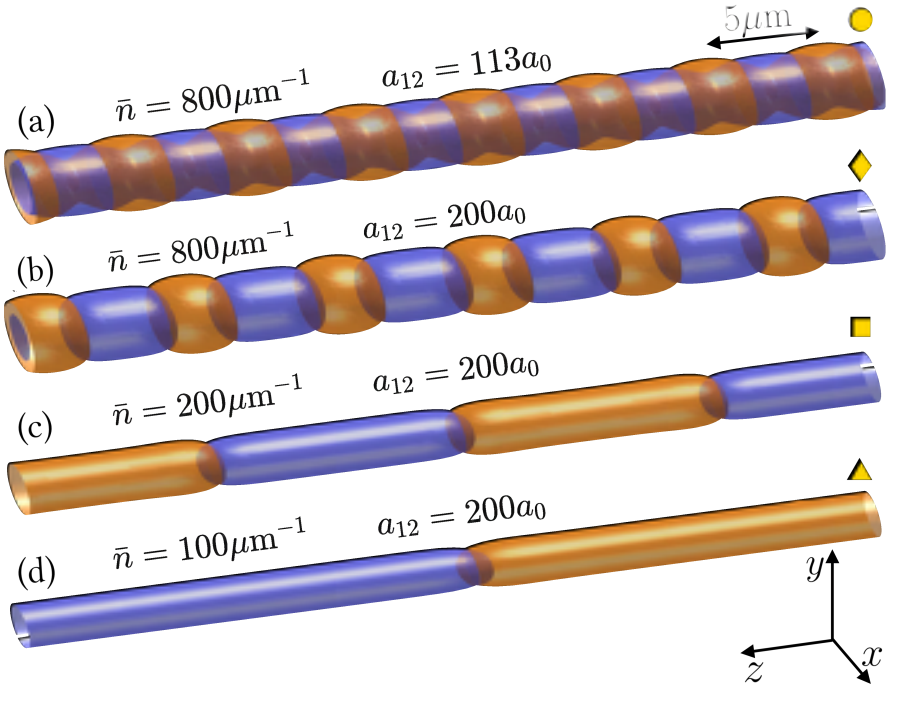
Anti-dipolar supersolids are anti-boring!
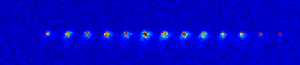
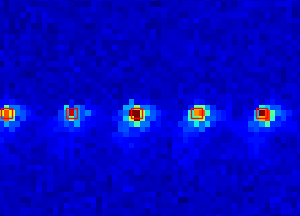
By rapidly rotating the dipole moment in an ultracold Bose gas it is possible to tune the dipole-dipole interaction. Rotating dipoles around the origin of the x-y plane, for example, gives a time averaged interaction that is equivalent to anti-dipoles oriented along the z axis! This means that the effective interaction is opposite: head-to-tail anti-dipoles repel, and side-by-side anti-dipoles attract! In an infinite tube of anti-dipoles, this means that the possible supersolid states have cylindrical symmetry around the x-y axis, which we utilize to facilitate analytic predictions, and faster numerical simulations, of two-component antidipolar supersolids!
See the pre-print here: arXiv:2301.08007
Review of recent experiments with dipolar gases
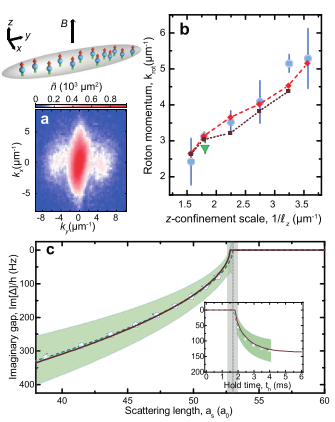
The last 15 years has seen tremendous experimental progress for the manipulation and control of ultracold atoms with sizeable dipole-dipole interactions. In this review, together with other group leaders who first condensed dysprosium and chromium, we review the discoveries made so far, and lay out the future perspectives for this exciting field!
The paper can be found here: Dipolar physics: a review of experiments with magnetic quantum gases – IOPscience