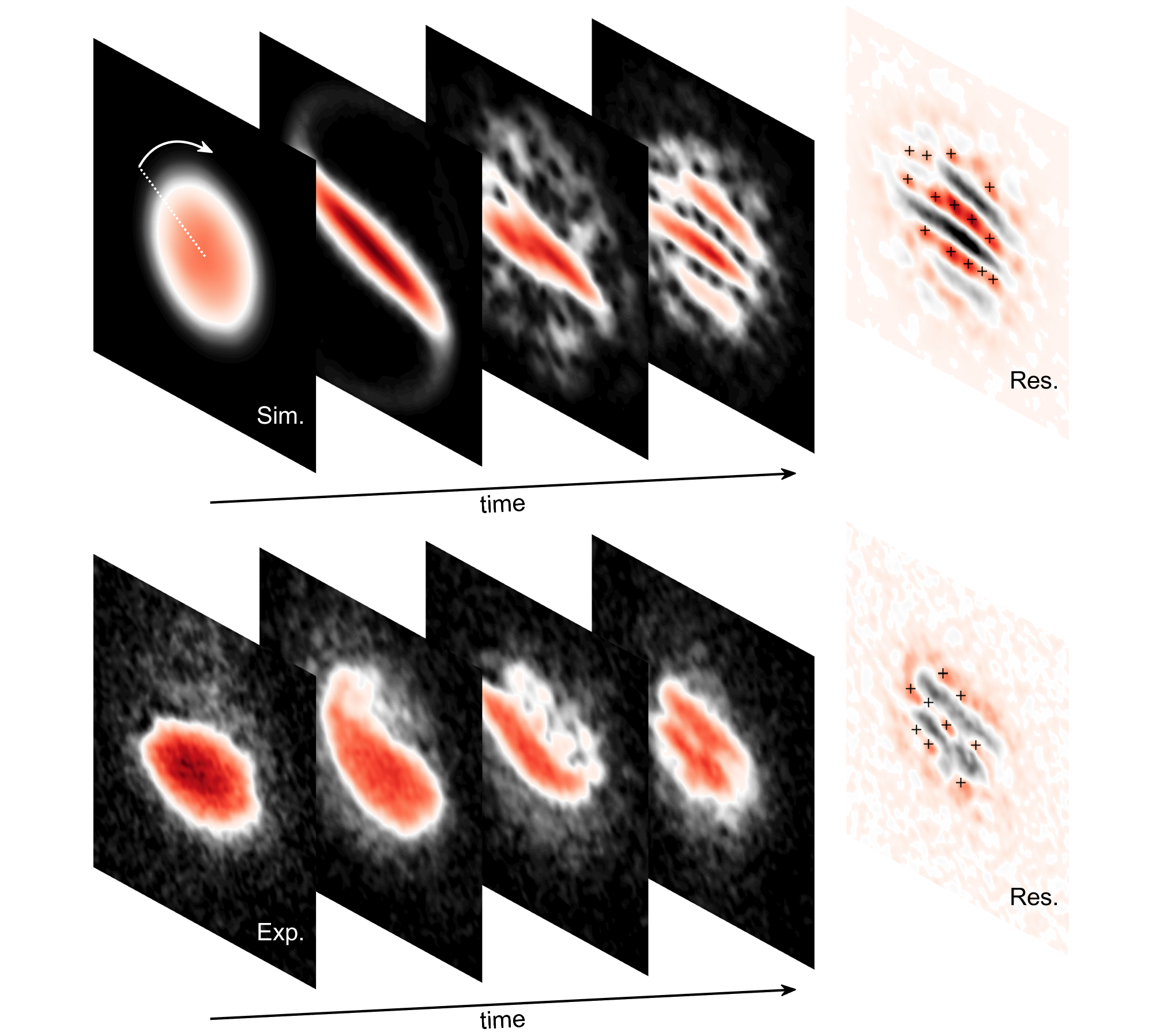
Following our recent experimental observation of vortices in Bose-Einstein condensates comprised of atoms with inherent long-range dipole-dipole interactions [Nat. Phys. 18, 1453-1458 (2022)], we thoroughly investigate vortex properties in the three-dimensional dominantly dipolar regime, where beyond-mean-field effects are crucial for stability, and investigate the interplay between trap geometry and magnetic field tilt angle. Last year, Jean Dalibard was awarded with the most prestigious French prize for physicists, the CNRS Gold medal, and this work is our contribution to a Special Issue honouring his many contributions to the field of ultracold atoms, and in particular his work on quantum vortices. See the full collection here: CNRS Gold Medal Jean Dalibard (academie-sciences.fr).
See the pre-print here: arXiv:2303.13263, and the now published paper here: C. R. Phys.
FF
A very excited dipolar quantum droplet
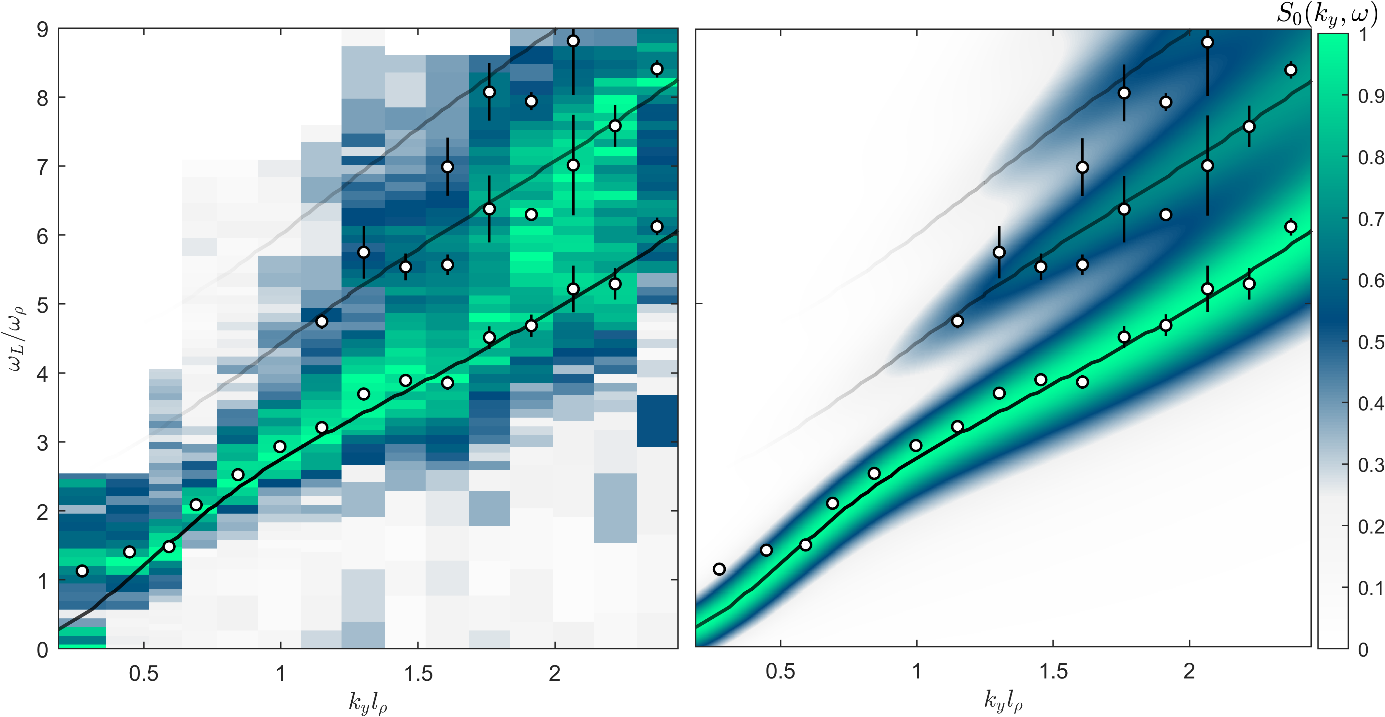
Now published in PRL! Together with collaborators from the University of Otago, we present the the excitation spectrum of Erbium at the crossover from a Bose-Einstein condensate to a trapped macrodroplet. The measurements coincide well with the predictions and confirm the peculiar features of this spectrum: a strong upward shift in energy at low momentum and the appearance of multiple excitation branches at higher momentum. It turns out that these features can be explained by the tendency of the excitations to avoid the central dense part of the droplet and by becoming more like ripples moving over the surface of a droplet!
Read it in Physical Review Letters, Phys. Rev. Lett. 132, 103401, and see the pre-print here: arXiv:2308.00003.
Alex wins a PhD dissertation prize!
Alex Patscheider, who finished his PhD with us last year, just received one of this year’s Hypo Tirol Prizes for his dissertation on controlling and understanding of dipolar quantum gases of erbium atoms. Congratulations! 👏
Currently, Alex works as a Quantum Network Engineer at the Canada-based quantum technology company Photonic Inc.
Heating a liquid into a… solid?!
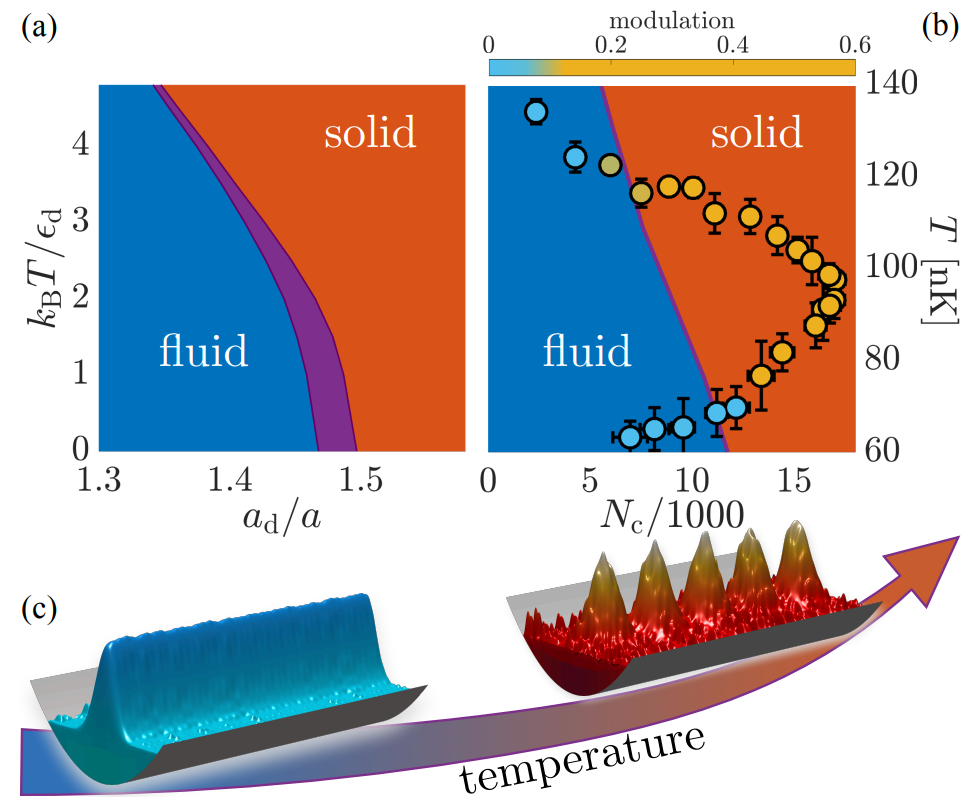
Raising the temperature of a material enhances the thermal motion of particles. Such an increase in thermal energy commonly leads to the melting of a solid into a fluid and eventually vaporises the liquid into a gaseous phase of matter. Here, together with theorists from Aarhus, Denmark, we study the finite-temperature physics of dipolar quantum fluids and find surprising deviations from this general phenomenology. In particular, we describe how heating a dipolar superfluid from near-zero temperatures can induce a phase transition to a supersolid state with a broken translational symmetry. The predicted effect agrees with our experimental measurements from the Er-Dy, which opens the door for exploring the unusual thermodynamics of dipolar quantum fluids.
See the pre-print here: arXiv:2209.00335 and the published paper here: Nature Communications (2023)